


Introduction
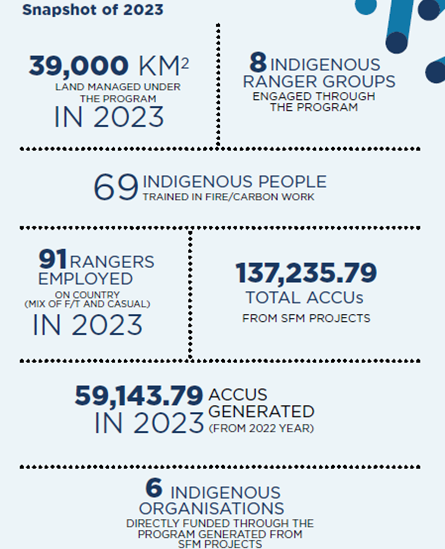
The Savanna Fire Management (SFM) Program is a funding initiative that provides approximately $2 million annually for 18 years. The program was launched in 2016 to support coordination, training, start-up, and early operational costs for new projects on Aboriginal Lands in the Top End of the Northern Territory. The program reduces entry barriers for Indigenous groups – who often have limited business development and employment opportunities – and facilitates the commencement of a carbon business.
Tropical savanna fires in Australia are responsible for over 4% of the country’s greenhouse gas emissions. Uncontrolled wildfires during the late dry season can cause significant harm to the environment and cultural sites, as well as release substantial amounts of greenhouse gases.
By implementing traditional fire management practices developed over thousands of years, Indigenous Rangers strategically set small fires during the early dry season. This not only helps protect Country and cultural heritage but also reduces greenhouse gas emissions enabling carbon businesses to be established along the way.
Currently, a quarter of Traditional Owner groups in northern Australia participate in the carbon economy, with many deterred by high start-up costs. The SFM Program plays a vital role in providing the necessary funding to establish new carbon projects.
Savanna Burning Methodology
Savannas in northern Australia are prone to late-season fires that result in large, intense fires producing a large amount of greenhouse gas emissions. The savanna fire management methodology utilised by these projects aim to minimise greenhouse gas emissions by reducing the extent and frequency of these fires.
Fire management activities take place throughout the year, with planned burning occurring primarily during the early dry season using several methods including igniting fires from aircraft, vehicles, boats, or walking, depending on landscape features within the project area.
Other fire management activities include creating firebreaks and undertaking fire suppression in the late dry season. The specific type and timing of fire management activities depend on the project area’s location and local environmental conditions.
How does the program work?
The SFM program operates in two phases.
Phase 1
Focuses on evaluating a group’s ability to develop a carbon business and includes assessments related to capacity and capability to deliver savanna burning methodologies. This phase also involves conducting vegetation mapping and utilising online tools like ‘SavBAT’ to assess the project’s viability. Additionally, the group must register with the Clean Energy Regulator and undergo assessments and planning related to workplace health and safety. The evaluation process also involves checking carbon baselines, vegetation, and fire history to identify areas where improvements can be made through better fire management.
Phase 2
On-ground fire management work and the ability to produce ACCUs (Australian Carbon Credit Units) starts in phase 2. The activities funded during this phase include wages for rangers and coordinators, infrastructure such as ranger sheds, plant and equipment, safety gear, helicopter hire and sourcing experts to assist.
Contact Us
If you have questions or would like to provide feedback, please email sfm@ilsc.gov.au